
Why Most Traders Lose Even When They Know What to Do
How Mark Douglas’ probabilistic discipline and Denise Shull’s emotional awareness create the foundation for consistent, professional trading.
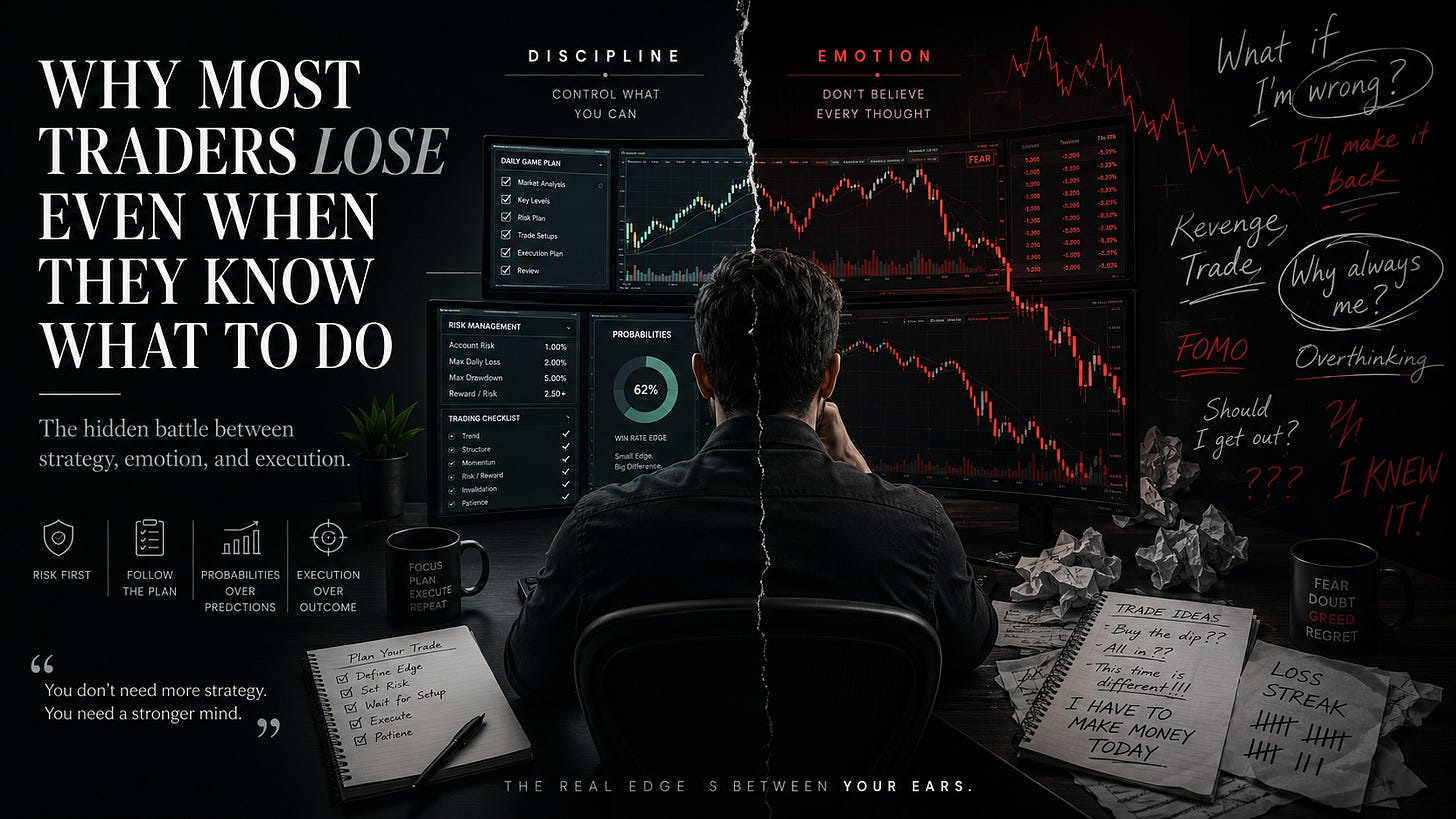
Most struggling traders fall into one of two categories. Some do not yet have a clearly defined strategy with a real edge. Others may have a workable method, but they do not fully understand all the moving parts that go into professional trading: market environment, risk management, position sizing, trade selection, execution, and review.
But once those pieces begin to come together, the next obstacle is often not technical. It is psychological. The single biggest factor I see separating traders who improve from traders who continue to struggle is their ability to manage the mental side of the game.
Many traders experience unnecessary pain for far too long before they understand this. Trading psychology may not feel as exciting as finding the next big winner, building a new scan, or studying a powerful chart pattern. But if the goal is to become a consistently profitable trader, mindset cannot be ignored. Strategy tells you what to do. Mindset determines whether you can actually do it when money, uncertainty, fear, and regret are involved.
Richard Dennis captured this reality when he said:
“I always say that you could publish trading rules in the newspaper and no one would follow them.”
Ed Seykota made the point even more directly:
“Win or lose, everyone gets what they want from the market. Some people seem to like to lose, so they win by losing money.”
Those quotes may sound extreme, but they point to one of the most uncomfortable truths in trading. Rules are not enough. A trader can know the right thing to do and still fail to do it if his need for action, certainty, validation, relief, or revenge becomes stronger than his commitment to the process.
The Execution Gap
Most traders do not fail because they lack access to information. They fail because they cannot consistently act on the information they already have. They know where the stop should be. They know when a setup is extended. They know when they are chasing, hesitating, forcing a trade, or holding a loser past the point where the original thesis has broken. Yet in the moment, under pressure, knowledge alone often proves insufficient.
That is the uncomfortable truth of trading psychology. The market does not merely test your analysis. It tests your tolerance for uncertainty, your ability to accept loss, your relationship with regret, and your capacity to follow a process when every emotional impulse is trying to pull you away from it. This is why two traders can study the same chart, identify the same setup, and still produce completely different results.
Mark Douglas, author of Trading in the Zone and The Disciplined Trader, built much of his work around this exact problem. His central argument was that consistent winners think differently from everyone else. They understand that trading is not about being right on any single trade, but about executing an edge repeatedly over a large enough sample size for probabilities to work. In the foreword to Trading in the Zone, Thom Hartle summarizes Douglas’ core contribution clearly: traders must learn to think in probabilities, even though that mindset is foreign to how most people are trained to operate in normal life.
Denise Shull, author of Market Mind Games, approaches the problem from another angle. Rather than treating emotion as something traders should simply suppress, Shull argues that feelings are deeply connected to perception, judgment, risk, and decision-making. Her framework does not give traders permission to act impulsively. It gives them a way to understand what their emotions are trying to reveal before those emotions turn into destructive behavior.
The strongest trading psychology framework is not Douglas versus Shull. It is Douglas plus Shull. Douglas gives the trader discipline, probabilistic thinking, and respect for process. Shull gives the trader emotional awareness, self-reading, and the ability to distinguish useful internal information from personal noise. Together, they form a more complete model for professional trading.
The Market Is an Unusual Psychological Environment
Most people are trained to succeed in structured environments. In school, there are assignments, deadlines, grades, and authority figures. In most careers, there are procedures, expectations, reviews, and organizational rules. Effort does not guarantee success, but there is usually some relationship between preparation, behavior, and outcome.
Trading removes much of that structure. The market does not know who you are, what you need, how hard you worked, or how badly you want a trade to work. It does not reward sincerity, punish arrogance on schedule, or provide the emotional closure that people are used to receiving in other areas of life. This is one reason highly intelligent and successful people often struggle when they enter the market.
Douglas makes this point directly in The Disciplined Trader. He argues that the market has no obligation to conform to a trader’s expectations, and that the responsibility for perception, behavior, and execution rests entirely with the trader. Unlike many social environments, trading requires the individual to create rules, follow them, and manage risk without external enforcement.
That is a far more difficult task than most beginners realize. A trader is free to enter, exit, add, reduce, stop out, hold, hesitate, revenge trade, overtrade, or walk away. That freedom is attractive at first, but it becomes dangerous when it is not governed by discipline. The market offers unlimited choice, but the trader must supply structure.
Why Strategy Alone Is Not Enough
A profitable strategy is necessary, but it is not sufficient. A trader can have a valid edge and still fail if he cannot execute it consistently. He can know the correct stop and still move it. He can understand position sizing and still trade too large. He can know that one trade is meaningless in a large sample size and still emotionally treat the next trade as a referendum on his intelligence.
This is why trading psychology cannot be reduced to motivation or confidence. The real issue is whether the trader can behave in alignment with his process while exposed to uncertainty. In Trading in the Zone, Douglas emphasizes that the goal of trading is consistent profitability, yet only a small percentage of traders achieve it because consistent winners think differently from everyone else.
That difference is not merely technical. It is psychological. The consistent trader does not need certainty before acting. He does not need the market to validate him after every trade. He understands that a losing trade can still be a good trade if it was executed according to plan, and a winning trade can still be a bad trade if it came from impulse, overconfidence, or undisciplined risk.
For most traders, that is difficult to accept. The human mind naturally wants to connect outcome with correctness. If a trade makes money, it feels right. If a trade loses money, it feels wrong, but markets do not work that cleanly. A good process can produce a losing trade, and a poor process can be temporarily rewarded.
The Douglas Framework: Think in Probabilities
Douglas’ great contribution is the idea that a trader must think probabilistically. That means accepting that any individual trade can win or lose, regardless of how strong the setup appears. The edge is not proven by one outcome. It is revealed over a series of trades executed with consistency.
This is easy to say and difficult to live. Many traders claim to believe in probabilities, but emotionally react as though every trade should work. When a trade fails, they take it personally. When a trade works, they become overconfident. When they miss a move, they feel punished. When they take three losses in a row, they begin questioning a strategy that may still be perfectly valid over the next one hundred trades.
Probabilistic thinking requires the trader to separate process from outcome. The question after a trade is not simply, “Did I make money?” The better question is, “Did I execute the trade I was supposed to execute?” Over time, this shift reduces emotional volatility because the trader is no longer allowing every individual trade to define his confidence.
Douglas’ framework is especially important for risk management. If anything can happen on any individual trade, then no trade deserves unlimited trust. Every position needs a predefined risk point, a logical stop, and a position size that keeps the trader emotionally and financially stable if the trade fails.
Outcome Quality Is Not Decision Quality
Annie Duke’s Thinking in Bets adds an important decision-making layer to Douglas’ trading psychology by giving traders a clean way to separate process from outcome. Duke’s core point is that most real-world decisions are made under uncertainty, with incomplete information and an unavoidable element of luck. This makes trading much more like poker than chess: a game of incomplete information, uncertain outcomes, and decisions that can be correct even when the result is unfavorable.
In chess, outcome and decision quality are closely connected. If a stronger player loses, it is usually possible to go back and find the mistake. Poker is different. A player can make the correct decision and still lose the hand. A player can make a poor decision and still win because the next card happens to save him. Duke calls this problem “resulting,” which means judging the quality of a decision only by the quality of the outcome.
This concept is directly applicable to trading. A trader can buy a proper breakout, size the position correctly, place a logical stop, follow every rule, and still take a loss. That does not automatically mean the trade was bad. It may simply mean that this particular outcome fell inside the normal distribution of losses that every edge must experience. The reverse is also true. A trader can chase an extended stock, ignore risk, get lucky, and make money. That does not mean the process was sound.
This is where Duke reinforces Douglas. Douglas teaches that traders must think in probabilities because any single trade outcome is uncertain. Duke gives that same idea a broader decision-making vocabulary: the goal is to evaluate the quality of the decision process, not emotionally overreact to the result. In her framework, better decision-making begins when we recognize that outcomes are shaped by both decision quality and luck.
For traders, this is not an academic distinction. It is the difference between learning correctly and training the wrong behavior. If a trader reviews only the result, he may punish himself for a good trade that lost or reward himself for a bad trade that worked. Over time, that creates confusion, inconsistency, and emotional instability. But when a trader reviews the process, he can ask better questions:
Did the setup meet my criteria?
Was the risk appropriate?
Did I follow my stop?
Did I manage the trade according to evidence, or did I react to fear, hope, or regret?
That is the professional standard. Winning does not automatically mean good trading, and losing does not automatically mean bad trading. The real question is whether the decision was made according to a repeatable process that can survive over a large sample size. That is where Douglas, Duke, and Shull connect: probabilistic thinking protects the trader from overreacting to outcomes, while emotional awareness helps the trader understand why he is tempted to do so.
The Shull Framework: Emotions Are Information, Not Instructions
Where Douglas emphasizes discipline and probability, Denise Shull emphasizes the role of emotion in perception and decision-making. Her argument is not that traders should act on every feeling. It is that feelings should be examined because they may contain information about risk, bias, uncertainty, or subconscious pattern recognition.
This is where many traders misunderstand emotional awareness. They assume the choice is either emotionless discipline or impulsive emotional trading. Shull offers a more nuanced view. The goal is not to obey emotion, the goal is to understand it before it becomes behavior.
A feeling of hesitation, for example, might be fear. It might also be the mind noticing that the setup is not as clean as the trader wants it to be. A feeling of confidence might reflect legitimate conviction, or it might be euphoria after a winning streak. A feeling of frustration might be irrelevant personal noise, or it might reveal that the trader is no longer seeing the market clearly.
Shull’s framework helps traders ask better questions.
What am I feeling?
Why am I feeling it?
Is this emotion connected to the market, or is it connected to my ego, fatigue, recent losses, or desire to be right?
Is this internal signal pointing to something I should evaluate, or is it simply pressure trying to push me away from my rules?
The Problem With Suppression
Many traders try to solve emotional problems by suppressing emotion. They tell themselves not to feel fear, greed, regret, or excitement. The problem is that suppressed emotions do not disappear. They often resurface as impulsive decisions, rationalized rule-breaking, or delayed emotional reactions.
A trader who refuses to acknowledge fear may move a stop and call it “giving the trade room.” A trader who refuses to acknowledge regret may chase a stock that is already extended. A trader who refuses to acknowledge anger may revenge trade after a loss and call it “staying aggressive.” The emotion is still there, but because it was not identified directly, it expresses itself through behavior.
This is why Shull’s work is useful. Emotional awareness creates space between feeling and action. Once a trader can name the emotion, he can evaluate it. Once he can evaluate it, he can decide whether it contains useful market information or whether it is simply personal noise that should not influence the trade.
The professional standard is not to become numb. The professional standard is to become aware enough that emotion no longer controls execution.
The Synthesis: Emotional Awareness With Disciplined Execution
The best framework combines Douglas and Shull into one operating model. Douglas tells the trader to respect probabilities, define risk, and execute consistently. Shull tells the trader to pay attention to emotional information without becoming a servant to it. The result is not emotional trading. It is emotionally informed discipline.
This distinction matters. A trader should not exit simply because he feels uncomfortable. Discomfort is part of trading. At the same time, he should not ignore discomfort if it is pointing to a real inconsistency in the setup, a shift in market character, or a violation of his own process. The emotion is not the decision-maker, but it may be a prompt to recheck the decision.
In practice, this means the trader can feel fear and still honor the stop. He can feel confidence and still respect position size. He can feel regret and still refuse to chase. He can feel frustration and still choose not to trade. Emotional maturity is not the absence of emotion. It is the ability to feel emotion without letting it override the system.
This is where trading becomes a performance discipline. Like an athlete under pressure, the trader must operate in real time with incomplete information, shifting conditions, and consequences attached to every decision. Gary Mack’s Mind Gym frames mental training as a critical part of performance, emphasizing that mental skills require practice just like physical skills.
The Best Traders Know How to Lose
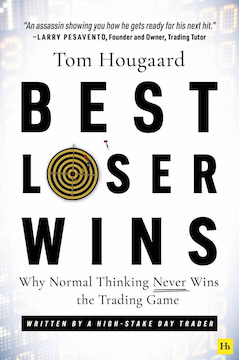
Tom Hougaard’s Best Loser Wins reinforces this same point from a different angle. Hougaard argues that most traders search in the wrong place. They look for the answer in technicals, fundamentals, indicators, patterns, and ratios, while the deeper issue is often how they respond to loss. His conclusion is blunt: the best loser wins.
This is a powerful concept because loss is unavoidable. Every trader will be wrong. Every trader will miss opportunities. Every trader will exit too early, hold too long, take a stop before a stock reverses, or watch a stock run without them. The difference is not whether these things happen. The difference is whether the trader can absorb them without damaging the next decision.
A poor loser turns one loss into three. He widens stops, doubles down, revenge trades, or abandons his process. A good loser accepts the loss as part of the business. He protects capital, protects mental clarity, and returns to the next trade without emotional debt.
This is why risk management is not just financial. It is psychological. If a position is too large, the trader will struggle to think clearly. If the loss is too painful, he will look for reasons to avoid taking it. If the outcome matters too much emotionally, he will stop reading the market objectively and start defending his position.
A Professional Framework for Applying This
A practical mental process begins before the trade is ever entered. The trader should know the setup, the entry, the stop, the position size, the market context, and the condition that would invalidate the trade. He should also know his emotional state before he puts capital at risk.
This last point is often ignored. A trader coming off a large win may be more vulnerable to overconfidence. A trader coming off a loss may be more vulnerable to revenge trading. A trader who is tired, distracted, or emotionally charged may interpret market information less clearly. The setup may be the same, but the trader is not the same.
During the trade, the objective is to observe without constantly renegotiating the plan. The trader should ask whether the trade is behaving in a way that still supports the original thesis. If it is, he manages it according to plan. If it is not, he exits or reduces risk based on predefined rules, not emotional discomfort alone.
After the trade, the review should focus on process quality.
Did the trade fit the setup?
Was the risk appropriate?
Was the stop respected?
Was the exit based on evidence or emotion?
Did the trader mistake fear for intuition, hope for conviction, or regret for opportunity?
Beginners Need Rules Before Intuition
There is one important caveat. Using emotions as market information is more useful for traders who already have experience, pattern recognition, and a defined process. For beginners, emotional signals are often unreliable because they may reflect inexperience rather than genuine market intuition.
A newer trader may feel fear simply because normal volatility feels threatening. He may feel confidence because he does not yet understand risk. He may feel urgency because he has not seen enough failed breakouts, reversals, or extended entries. At that stage, rules matter more than interpretation.
This is why Douglas should come before Shull in the development process. First, the trader needs structure: defined setups, position sizing, stops, journaling, and review. Only then can emotional awareness become a useful layer rather than a license for impulse.
In other words, emotions can become valuable data, but only after the trader has enough experience to interpret them correctly. Without experience, emotion becomes justification. With structure, emotion becomes information.
The Real Edge Is Self-Control Under Uncertainty
The market will always create uncertainty. It will always tempt the trader to abandon rules at the worst possible moment. It will always make the obvious feel uncomfortable and the dangerous feel appealing. That is why the mental side of trading is not secondary to the strategy. It is the mechanism that determines whether the strategy can actually be executed.
Mark Douglas teaches traders to think in probabilities and detach from the emotional weight of any single outcome. Denise Shull teaches traders to examine emotion as part of the decision-making process rather than pretending it does not exist. Tom Hougaard reminds traders that the ability to lose well is one of the most important advantages in the game. Gary Mack’s performance framework reinforces that mental skills must be trained, not merely understood.
The professional trader is not the person who never feels fear, frustration, regret, or excitement. The professional trader is the person who can feel those things and still behave according to process. He can listen to emotion without being ruled by it. He can accept uncertainty without needing prediction. He can take losses without turning them into identity wounds.
That is the real foundation of consistency. Not perfect analysis. Not perfect conviction. Not perfect timing. The foundation is the ability to remain disciplined, emotionally aware, and process-driven while the market is doing everything it can to pull you away from your plan.
Continue Building the Mental Side of Your Trading
The ideas in this article are only the starting point. In the upcoming Momentum Trading Strategy Course module on trading psychology and mindset, we will go deeper into how professional traders develop the emotional control, probabilistic thinking, and daily routines needed to execute consistently under pressure.
This is not just theory. These lessons are also built into the way we plan trades, manage risk, review decisions, and build a repeatable trading process inside Momentum Trading Strategy. The goal is not simply to understand trading psychology intellectually. The goal is to turn it into a practical routine that shapes how you prepare before the market opens, how you respond while a trade is live, and how you review your execution after the trade is closed.
Inside the course, we will take many of the concepts discussed here, including emotional awareness, outcome versus process review, loss acceptance, position sizing, trade planning, journaling, and post-trade reflection, and show how they fit into a real-world trading process.
Because at the end of the day, consistency is not built by reading one article, memorizing one quote, or finding one perfect setup. It is built by following a process, putting in the repetitions, and training yourself to think, prepare, execute, and review like a professional.
That is the purpose of Momentum Trading Strategy.
Want to Go Deeper?
All-Access includes the Momentum Trading Strategy Course, MTS Velocity software, and the Big Picture Market Pulse newsletter.
