
Marty Zweig’s Rules: Don’t Fight the Fed, Don’t Fight the Tape, and Don’t Fight Yourself
Why Winning on Wall Street still matters for growth stock investors, momentum traders, and anyone trying to stay aligned with the market’s major trend
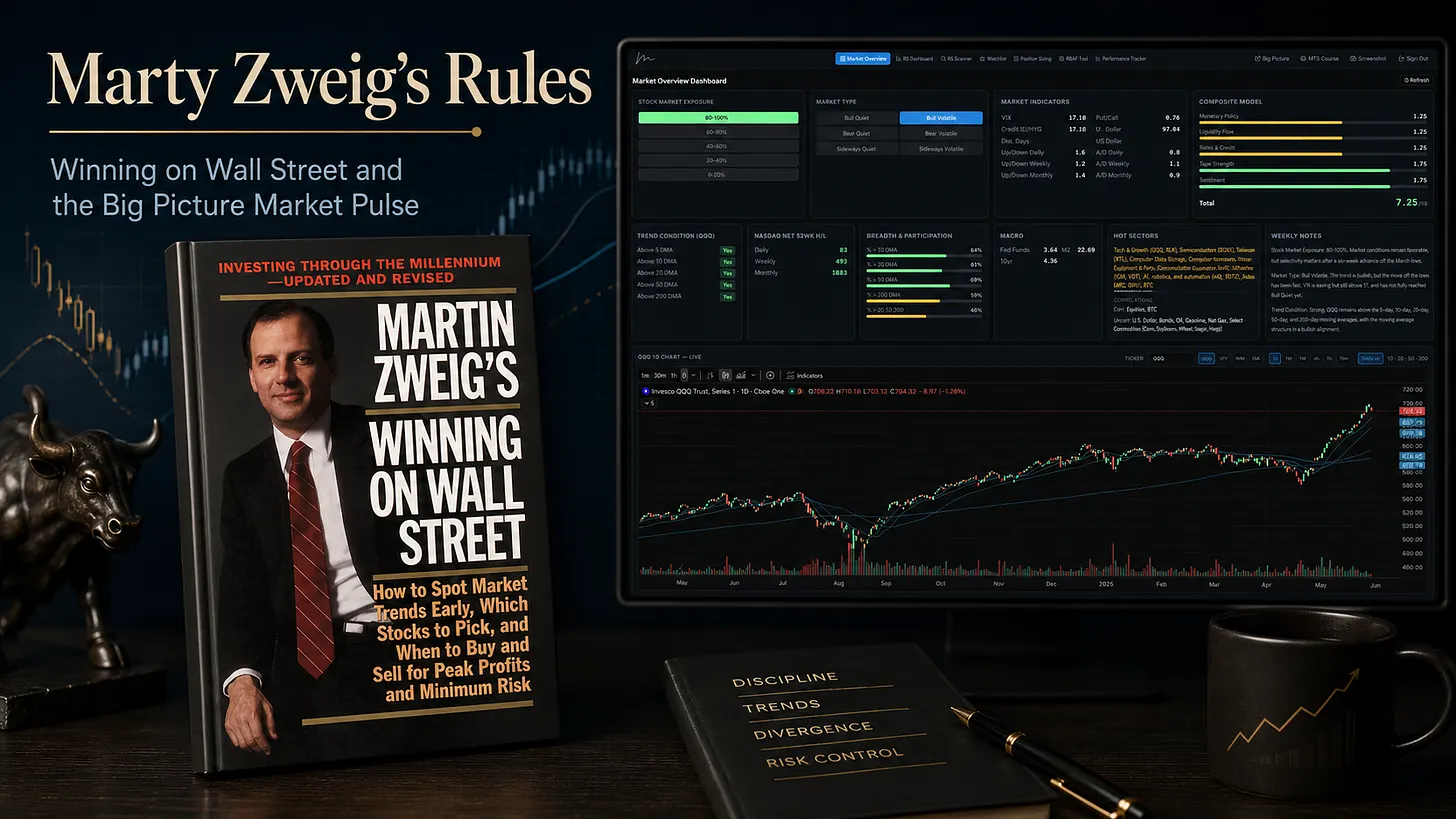
In Jack Schwager’s first Market Wizards book, he interviewed some of the greatest traders of the modern era. These were traders with very different styles, different time frames, different markets, and different ways of thinking about risk. Some were macro traders. Some were trend followers. Some were discretionary. Some were systematic.
But one thing stood out to me as I read through those interviews. When Schwager asked many of them which analysts they respected or followed, the same name kept appearing: Marty Zweig.
Bruce Kovner mentioned him. Michael Marcus mentioned him. Richard Dennis mentioned him. Paul Tudor Jones mentioned him. These were not traders who all approached the market the same way, yet they all seemed to respect Zweig’s work.
That caught my attention.
My own foundation has been built primarily on William O’Neil, especially How to Make Money in Stocks, along with Mark Minervini’s work in Trade Like a Stock Market Wizard and Think & Trade Like a Champion. I have always been drawn to growth stocks, relative strength, institutional accumulation, earnings acceleration, leadership, and the practical discipline of buying the strongest stocks in the strongest market environments.
But after seeing Zweig’s name come up repeatedly among the Market Wizards, I could not resist picking up a copy of Winning on Wall Street to understand why so many elite traders, many of whom traded in completely different ways, paid attention to him.
What I found was not a contradiction to the O’Neil or Minervini approach. It was a deeper explanation of something already embedded in CAN SLIM: the “M,” or market direction.
O’Neil taught that three out of four stocks move with the general market. That single principle is one of the most important ideas in growth stock investing. You can find a great company, with great earnings, in a strong industry group, showing excellent relative strength, but if the general market is under distribution or liquidity conditions are working against risk assets, the probability of success is lower.
Zweig helped me understand that market component at a deeper level. His work connected monetary policy, interest rates, market momentum, sentiment, and tape action into a broader framework for understanding the environment. It gave structure to the idea that investors should not fight the Fed, should not fight the tape, and should not let opinion override evidence.
That thinking became one of the influences behind my own Big Picture Market Pulse, which I publish every weekend. I do not believe every trader needs to analyze the market this deeply. In fact, many traders can succeed with a much simpler process if they stay disciplined, manage risk, and focus on leading stocks. But for me, studying the broader market environment has become useful. It helps me zoom out, understand where we may be in the cycle, evaluate what type of market we are in, and decide whether the wind is at my back or in my face.
Some traders may hear that and think it contradicts Minervini’s emphasis on bottom-up stock selection. I do not see it that way. Minervini has often emphasized that most of his work (95%) is focused on individual stocks, not trying to predict the economy or make broad top-down forecasts. I agree with that. The individual stocks are still where the real work happens.
The way I approach it is both top-down and bottom-up.
When the market is closed, usually over the weekend, I zoom out and study the big picture. I look at the indexes, breadth, leadership, interest rates, credit conditions, sentiment, and overall market health. That gives me a read on the environment. It tells me whether conditions are favorable, mixed, or dangerous.
But once that work is done, the focus shifts back to individual stocks. I want to know which stocks are holding up best, which stocks are showing relative strength, which groups are attracting capital, which names are building proper bases, and which stocks are acting well even when the general market is weak.
That is the bottom-up work and refinement.
The market work helps me understand the environment. The stock work tells me where the opportunity is. I want both. I want to know the wind direction, but I also want to know which stocks are strong enough to lead when the wind turns favorable.
In that sense, Zweig’s work did not replace O’Neil or Minervini for me. It added another layer. It helped me better understand the market backdrop behind the individual stock setups. It helped me connect the “M” in CAN SLIM with monetary policy, momentum, sentiment, and tape action.
This is similar to how planning works in the U.S. military planning process. Higher headquarters provides the mission, commander’s intent, key tasks, purpose, and broader operational framework. Subordinate units then conduct their own analysis and develop the detailed plan for how they will execute that intent on the ground. The higher level defines the objective and desired end state. The lower level refines the execution based on the reality of terrain, timing, resources, and conditions.
That is how I view market analysis. The big picture helps define the environment, the risk level, and the broader market direction. The individual stock work shows me where real leadership is developing, where the best opportunities are forming, and how and when to execute. Sometimes the strongest stocks begin setting up before the market environment looks perfect, which is why the bottom-up work is so important. When the top-down market environment and the bottom-up stock evidence begin to align, that is usually where the best trading opportunities appear, with the best risk/reward and a higher probability of success.
The Core of Zweig’s Philosophy
Zweig’s philosophy began with humility. He understood that no investor is smarter than the market all the time. The market can ignore logic longer than most people can stay solvent, and even the best analysis can fail if it is not aligned with price, liquidity, and investor psychology.
Rather than build a process around prediction, Zweig built a process around evidence. He wanted to know whether monetary conditions were supportive or restrictive, whether the tape was confirming strength or weakness, whether sentiment showed excessive optimism or pessimism, and whether his own risk controls were forcing him to respect the market’s message.
This was not a permanently bullish or permanently bearish approach. Zweig believed in flexibility. When conditions were favorable, he wanted to be invested. When risk rose, he wanted to cut back. When the evidence was mixed, he was willing to play defense and wait for a better pitch.
That is one of the most important lessons in his work. The market does not require investors to have an opinion every day. It requires them to recognize when the odds are favorable enough to act and when the risk is high enough to step aside.
Don’t Fight the Fed
Zweig’s most famous rule was also one of his most important: don’t fight the Fed.
In Winning on Wall Street, Zweig made it clear that Federal Reserve policy and interest rates play a major role in determining the broad direction of the stock market. When monetary conditions are favorable, investors have a tailwind. When monetary conditions deteriorate, the market faces a headwind.
This does not mean stocks rise every time the Fed eases or fall every time the Fed tightens. Zweig was not that simplistic. His point was that monetary policy changes the probabilities. Easy money tends to support liquidity, risk appetite, and higher equity prices. Tight money tends to restrict liquidity, pressure valuations, and increase the probability of market trouble.
To measure this, Zweig developed a Monetary Model that combined several indicators, including the Prime Rate Indicator, the Fed Indicator, and the Installment Debt Indicator. The model ranged from 0 to 8 points. A reading of 6 or higher generated a buy signal, while a drop to 2 or lower generated a sell signal.
The deeper lesson is not that investors today should blindly copy the exact model. The lesson is that liquidity matters. For growth stock investors, this is especially important because growth stocks are highly sensitive to changes in risk appetite, interest rates, and the willingness of investors to pay for future earnings. When liquidity is abundant, leading growth stocks can make extraordinary advances. When liquidity contracts, those same stocks can suffer severe declines.
That is why “don’t fight the Fed” is not just a macro rule. It is a risk management rule. It reminds investors that the best stock setups usually work better when the broader liquidity environment is supportive.
Don’t Fight the Tape
If “don’t fight the Fed” was Zweig’s monetary rule, “don’t fight the tape” was his market behavior rule.
The tape is the market itself. It is price action, volume, breadth, leadership, and momentum. Zweig believed the tape was the final judge. An investor may have a strong opinion, a convincing forecast, or a well-researched thesis, but if the market is moving against that view, the market is delivering important information.
This is where Zweig’s work connects directly with momentum investing. He did not believe investors needed to buy the exact bottom or sell the exact top. In fact, he argued against that obsession. The objective was not perfection. The objective was probability.
A trader does not need to buy the low of a new bull market. He can buy after the market has turned and the probability of further advance has improved. He does not need to sell the exact high either. He can sell after the evidence has deteriorated and the probability of further decline has increased.
That is a professional way to think about markets. Amateurs obsess over tops and bottoms. Professionals focus on evidence, risk, reward, and probability.
Zweig’s Four Percent Model was one way he measured the tape. The model used weekly changes in the Value Line Index. A weekly rise of 4% or more generated a buy signal, while a weekly decline of 4% or more generated a sell signal. What is most interesting is that the model did not require a high win rate to be useful. Some signals failed, but the larger winning signals more than compensated for the smaller losses.
That is the logic of trend following. The goal is not to be right on every trade. The goal is to limit losses when the signal fails and participate meaningfully when the trend becomes powerful.
This is why “don’t fight the tape” remains one of the most important rules in trading. If the indexes are breaking down, breadth is deteriorating, leadership is failing, and volume is confirming distribution, the tape is warning you. If the indexes are breaking out, breadth is improving, leadership is expanding, and leading stocks are acting well, the tape is also telling you something. You do not have to agree with it, but you do have to respect it.
The Power of Combining the Fed and the Tape
The real strength of Zweig’s framework was that he did not look at monetary policy or momentum in isolation. He combined them.
In Winning on Wall Street, Zweig described the combination of monetary and momentum indicators as the foundation of his most important investment model. He took his Monetary Model and added the Four Percent Model to create what he called the Super Model. The Monetary Model could contribute up to 8 points, while the Four Percent Model added 2 points when it was on a buy signal. Together, the Super Model ranged from 0 to 10.
The logic was powerful because it brought together two different but related forces. Monetary conditions described the environment. The tape described what investors were actually doing inside that environment.
When monetary conditions were favorable and the tape was strong, Zweig had the strongest evidence for being aggressive. When monetary conditions were poor and the tape was weak, the evidence argued for defense. When the two were in conflict, the message was more nuanced. The investor did not have to force a conclusion. He could reduce exposure, stay flexible, and wait for the evidence to align.
This remains one of the most useful lessons in the book. Many investors are too one-dimensional. Some focus only on the economy or the Fed, but they miss the fact that the market can trend higher long before the news improves. Others focus only on charts, but they ignore the liquidity conditions that can either support or undermine a move.
Zweig’s framework solved that problem by combining both. He respected macro conditions, but he still required confirmation from the tape. He respected momentum, but he did not ignore the monetary backdrop.
For modern growth stock investors, that combination is invaluable. The strongest opportunities usually occur when liquidity conditions, index trends, breadth, leadership, and individual stock action are all pointing in the same direction. When those pieces are not aligned, the trader should be more selective, reduce size, or wait.
Sentiment: When to Part Company With the Crowd
Zweig also understood that markets are driven by psychology. Prices move because people make decisions under the influence of fear, greed, hope, regret, and competition. That is why sentiment was an important part of his process.
He tracked a wide range of sentiment indicators, including mutual fund cash levels, advisory sentiment, bullish advertisements, secondary offerings, put/call ratios, short-selling activity, odd-lot activity, insider trading, margin debt, initial public offerings, and speculative volume. The specific indicators may have evolved over time, but the principle remains the same: crowd psychology often becomes most dangerous near extremes.
When optimism becomes excessive, investors often assume risk has disappeared. They become comfortable, aggressive, and willing to pay almost any price for future upside. That is often when risk is rising. When pessimism becomes extreme, investors often assume opportunity has disappeared. They become fearful, defensive, and unwilling to buy even when risk has already been reduced. That is often when opportunity begins to form.
But Zweig did not use sentiment as a standalone timing tool. This distinction matters. Extreme optimism can persist during a powerful bull market, and extreme pessimism can persist during a bear market. Sentiment had to be interpreted alongside monetary conditions and the tape.
That is still the proper way to use sentiment today. Put/call ratios, investor surveys, cash levels, IPO activity, meme stock speculation, social media euphoria, and options activity can all provide useful information, but they should not override the market’s actual trend. Sentiment is a warning system, not a complete investment model.
The 1987 Crash: Strategy Over Prediction
One of the most important sections of Winning on Wall Street is Zweig’s discussion of the 1987 crash. The lesson is not simply that he saw risk rising before Black Monday. The more important lesson is how he handled uncertainty.
Zweig did not claim to know with certainty that a crash was coming. In fact, he repeatedly emphasized that he was dealing in probabilities, not certainties. His indicators were negative, but not uniformly catastrophic. Monetary conditions were only moderately bearish, sentiment was not at an extreme, and the tape had weakened. What concerned him was the broader pattern of overvaluation, narrowing leadership, a speculative advance, and similarities to prior dangerous market periods.
Instead of making a dramatic forecast and betting everything on being right, he adopted a strategy. He reduced exposure. He used stops. He placed a small portion of the portfolio into put options as protection against a severe break. If he was wrong, the loss on the hedge would be limited. If he was right, the hedge could protect the portfolio from a major decline.
On October 19, 1987, the Dow fell 22.6%. Zweig’s portfolio rose 9%.
That result was not the product of certainty. It was the product of risk management. Zweig understood that the goal was not to predict the future perfectly. The goal was to structure the portfolio so it could survive unfavorable outcomes and benefit when the probabilities played out.
This is one of the most important lessons any trader can learn. Most traders want certainty before they act. Professionals know certainty is unavailable, so they build strategies that can survive uncertainty.
Discipline, Flexibility, and Patience
Zweig’s rules were not only about indicators. They were about behavior.
He believed investors needed discipline, flexibility, and patience. Discipline meant following a tested process instead of reacting emotionally to every headline, tip, or opinion. Flexibility meant changing your position when the evidence changed. Patience meant waiting for conditions to become favorable before taking large risks.
Many traders have one of those traits, but not all three. Some are disciplined but not flexible, so they hold a view long after the market has proven it wrong. Others are flexible but not disciplined, so they constantly change opinions without a stable process. Some are patient until they see other people making money, then they abandon their plan and chase.
Zweig understood that the market punishes all of these weaknesses. That is why he believed in rules, models, stops, and exposure control. The point was not to remove judgment entirely. The point was to prevent emotion from taking control at the exact moment when discipline matters most.
This is where “don’t fight yourself” becomes just as important as “don’t fight the Fed” or “don’t fight the tape.” The investor’s greatest enemy is often internal. Ego keeps people from taking losses. Hope keeps people in broken stocks. Fear keeps people from buying when the odds improve. Greed keeps people overexposed when risk is rising.
A rule has to exist before the emotion arrives. Once the position is on and money is at risk, judgment becomes much harder.
What Growth Stock Investors Can Learn From Zweig
For growth stock investors and momentum traders, Zweig’s framework remains highly relevant.
Start with the market environment. Is monetary policy supportive or restrictive? Are interest rates helping or hurting risk appetite? Is liquidity expanding or contracting? These questions matter because even the best growth stocks usually perform better when the broader environment supports risk-taking.
Then study the tape. Are the major indexes above key moving averages? Is breadth improving or deteriorating? Are leading stocks breaking out of sound bases, or are breakouts failing? Are strong groups attracting capital, or is leadership narrowing? The tape shows whether institutions are accumulating risk or distributing it.
Then evaluate sentiment. Are investors fearful, skeptical, and underexposed, or are they euphoric, complacent, and chasing extended stocks? Sentiment does not replace price action, but it helps identify when the crowd may be leaning too far in one direction.
Finally, manage exposure. Zweig did not treat investing as an all-in or all-out exercise. He believed exposure should rise when conditions improve and fall when risk increases. That principle is especially important for momentum traders because market conditions can change quickly. The same strategy that works beautifully in a healthy advance can become dangerous in a deteriorating tape.
This is where Zweig’s work fits naturally with a modern growth stock process. The best opportunities tend to appear when the Fed, the tape, leadership, breadth, and individual stock setups are aligned (think 2020-2021 bull market). When that alignment weakens, the trader does not need to become emotional or make predictions. He simply needs to reduce risk and wait for the evidence to improve.
Why Zweig’s Rules Still Matter
Marty Zweig’s rules have lasted because they are rooted in how markets actually work. Liquidity matters. Trend matters. Psychology matters. Risk management matters. Discipline matters.
The tools have changed. The speed of information has changed. The market structure has changed, but the core problem has not changed. Investors still have to decide when to be aggressive, when to be defensive, and when to do nothing. They still have to fight the temptation to impose their opinions on the market. They still have to manage risk when the evidence turns against them.
That is why “don’t fight the Fed” still matters. It reminds investors that liquidity and monetary conditions influence the market’s appetite for risk.
That is why “don’t fight the tape” still matters. It reminds investors that price action is not something to argue with. It is evidence.
And that is why discipline still matters. A model is useless if the investor cannot follow it. A rule is meaningless if it is abandoned under pressure. A process only works if it survives contact with fear, greed, and uncertainty.
Zweig’s genius was not that he made investing complicated. It was that he made the important things measurable. He gave investors a way to think in probabilities instead of opinions. He showed that you do not have to catch the exact top or bottom. You do not have to be right all the time. You do not have to predict the future.
You need a process that keeps you aligned with the major forces driving the market, protects you when risk rises, and gives you the confidence to act when opportunity improves.
That is the lasting lesson of Marty Zweig.
Don’t fight the Fed. Don’t fight the tape. Don’t fight yourself.
Want to Go Deeper?
All-Access includes the Momentum Trading Strategy Course, MTS Velocity software, and the Big Picture Market Pulse newsletter.
