
The Position Sizing Game That Shows Why Good Strategies Still Fail
How Dr. Van Tharp’s Marble Game reveals how position sizing connects expectancy, drawdown, risk tolerance, and long-term trading performance
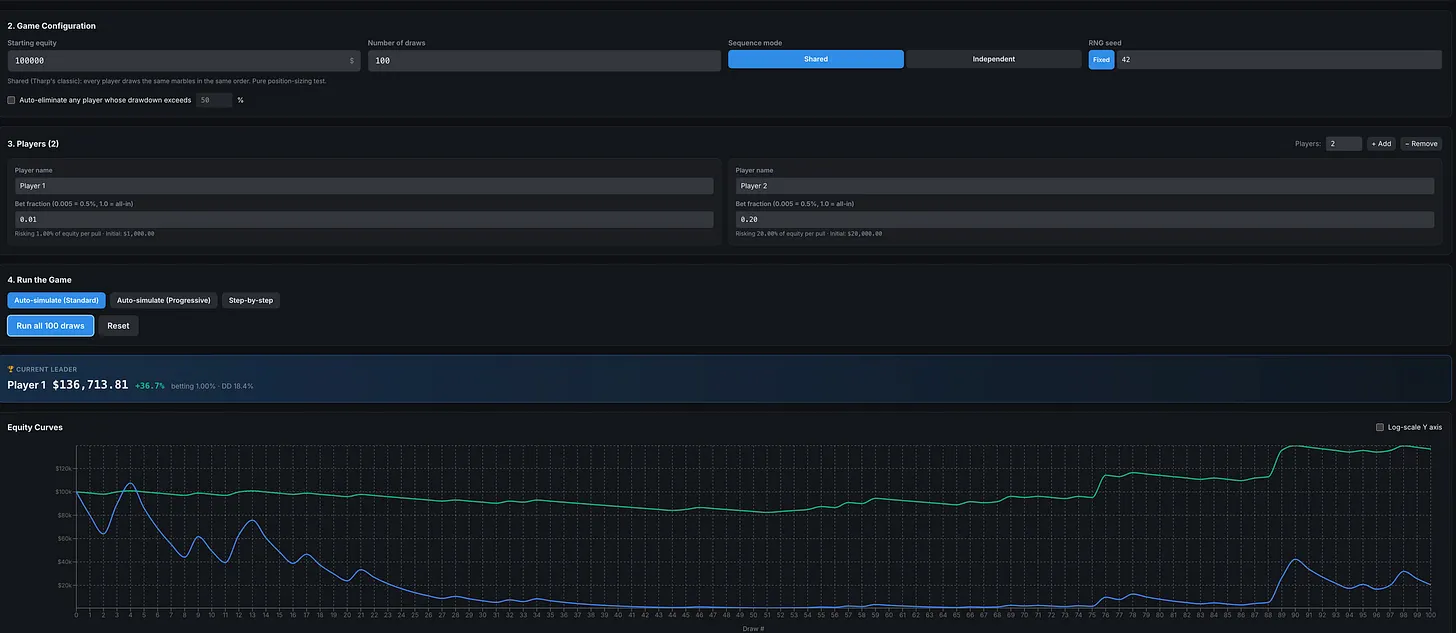
Most traders spend years trying to improve their entries. They study chart patterns, breakout signals, moving averages, market timing, relative strength, volume confirmation, and every other variable that might help them identify a better trade. Those things matter, but they are not the whole system.
One of Dr. Van Tharp’s most important contributions to trading education was his emphasis on position sizing. His Marble Game is one of the simplest and most effective ways to understand why. The game removes nearly every variable traders usually obsess over and isolates one question: how much should you risk when you already have a positive expectancy system?
That question is more important than most traders realize.
The Basic Concept
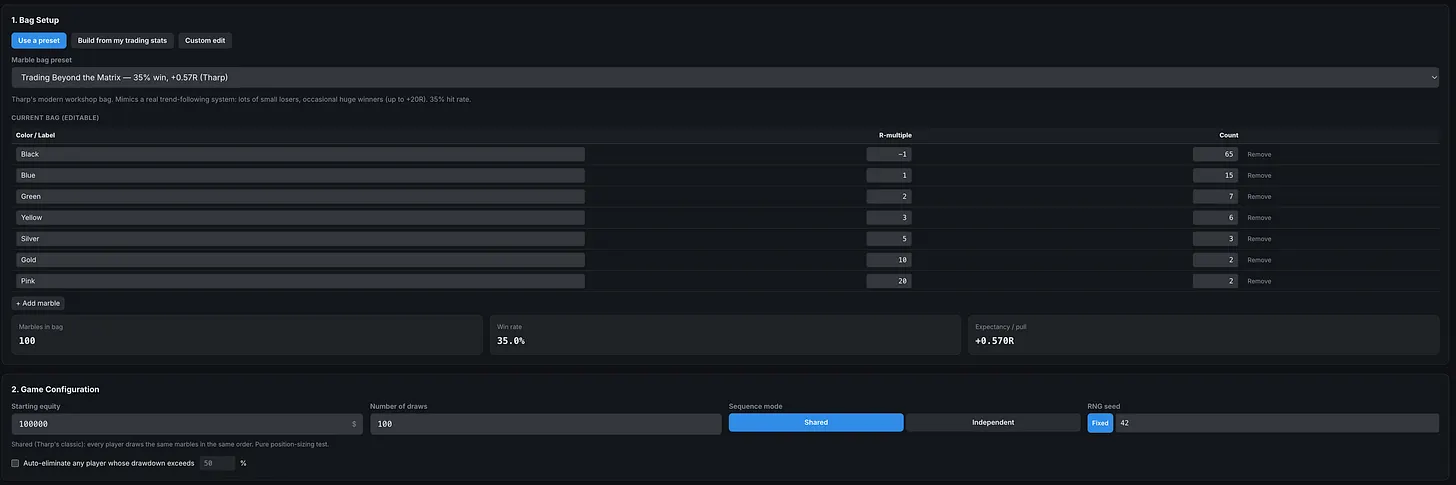
In the Marble Game, each marble represents a trade outcome. Some marbles are losers. Some are modest winners. Some represent larger R-multiple winners. A few may represent the type of outlier trades that drive the long-term profitability of many trend-following and momentum systems.
Every player receives the same sequence of outcomes. The entry does not change. The exit does not change. The edge does not change. The only variable is position size.
That is what makes the exercise so powerful. When every participant receives the same trades, the wide range of ending equity results cannot be blamed on stock selection, market timing, or the quality of the trading system. It comes from how each person sized the same set of opportunities.
Why This Matters
This is the part of trading that often gets underappreciated. A profitable system does not automatically produce a profitable trader. A positive expectancy model still has to be traded at a size that allows the trader to survive losing streaks, remain emotionally stable, and stay with the process long enough for the edge to express itself.
A trader can risk too much and destroy the account before the system has time to work. A trader can risk too little and fail to compound meaningfully. The correct answer is not simply the size that produces the highest theoretical return. The correct answer is the size that fits the system, the trader’s objectives, and the trader’s real-world drawdown tolerance.
That is the purpose of bringing the Marble Game into the Momentum Trading Strategy app.
Bringing the Marble Game Into the Momentum Trading Strategy App
The app turns the exercise into a practical position sizing lab. Traders can test different system profiles, including lower win-rate systems with larger winners, more balanced swing trading systems, and higher win-rate systems.
They can adjust win rate, average gain, average loss, R-multiple distribution, number of draws, starting equity, and risk per trade. They can also use their own trading statistics from the performance tracker to model how their actual results might behave under different sizing assumptions.
This matters because different trading systems require different sizing approaches. A 30% win-rate system with large outlier winners is not the same as a 50% win-rate system with smaller average gains. Both can have positive expectancy, but the experience of trading them can be completely different. One may require the trader to sit through more frequent losing streaks. The other may feel smoother but offer less outlier potential. The position size that fits one system may be completely inappropriate for the other.
The Marble Game makes that visible.
The Difference Between Theoretical Return and Tradable Return
A trader risking 1% per draw may experience a relatively controlled equity curve. A trader risking 5% may produce much higher returns in some runs, but may also experience drawdowns that are unacceptable in real life. A trader risking 10% may occasionally generate extreme results, but the path will often be unstable, inconsistent, and psychologically difficult to follow.
That is the key distinction between theoretical return and tradable return.
A strategy that produces the highest ending equity in a simulation is not necessarily the best strategy for a real trader. If the path includes a 60%, 70%, or 80% drawdown, most traders will abandon the system long before the final result matters. In professional terms, the issue is not just return. It is the path of return.
Fixed Sizing Versus Progressive Exposure
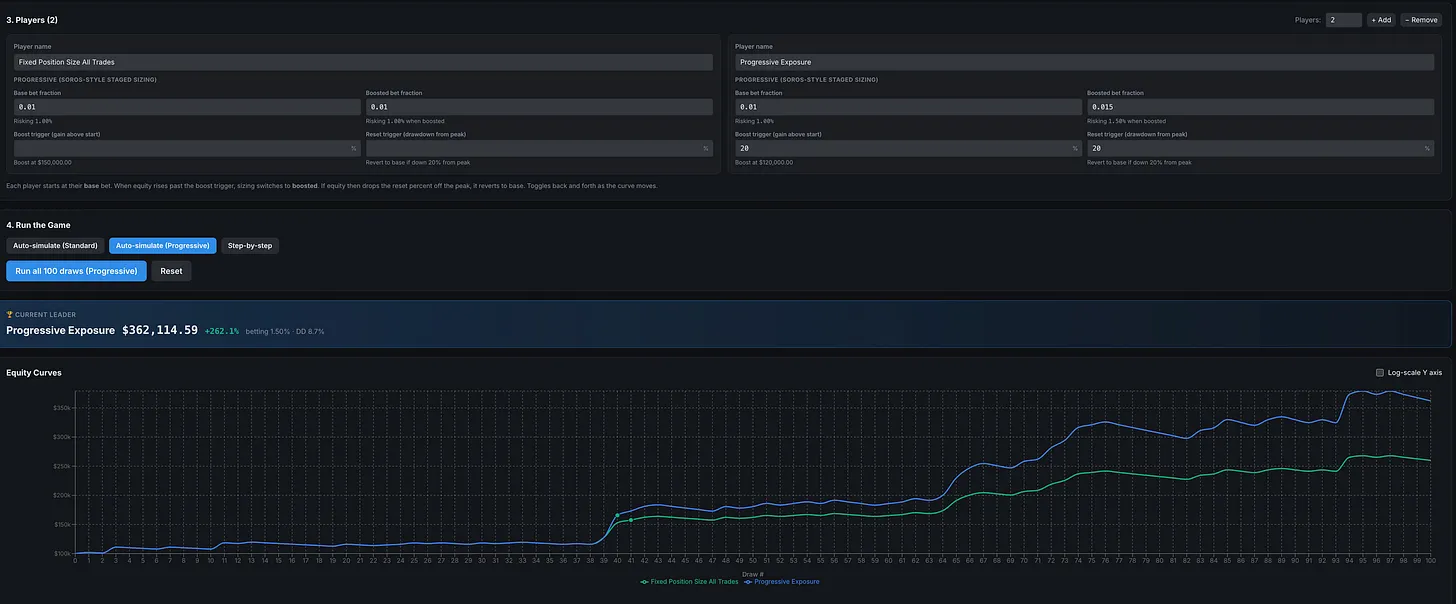
The app also allows traders to test progressive exposure, which is one of the most important practical extensions of the original game.
Fixed sizing assumes the trader risks the same amount on every trade, regardless of whether the equity curve is improving or deteriorating. Progressive exposure allows the trader to increase size when the account is performing well and reduce size when the account moves into drawdown.
That concept closely reflects how many successful traders manage risk in practice. They do not press when they are out of sync. They do not trade every environment the same way. They increase exposure when conditions are favorable and reduce exposure when the evidence deteriorates.
The value of the simulation is that it allows traders to test that idea directly. One player can use a fixed risk model. Another can start at the same risk level but increase exposure after reaching a performance threshold, then reduce exposure when drawdown begins. Both players can receive the same sequence of trade outcomes, allowing the trader to study how the sizing model changes the final result and the drawdown profile.
This is where the lesson becomes more practical than theoretical.
The goal is not to prove that one sizing method is always superior. The goal is to study the trade-off. Did the increased exposure produce meaningfully higher returns? Did it create materially larger drawdowns? Did the trader improve the return profile without creating an equity curve that would be too difficult to follow in real life?
Those are the questions serious traders should be asking.
Why Drawdown Limits Matter
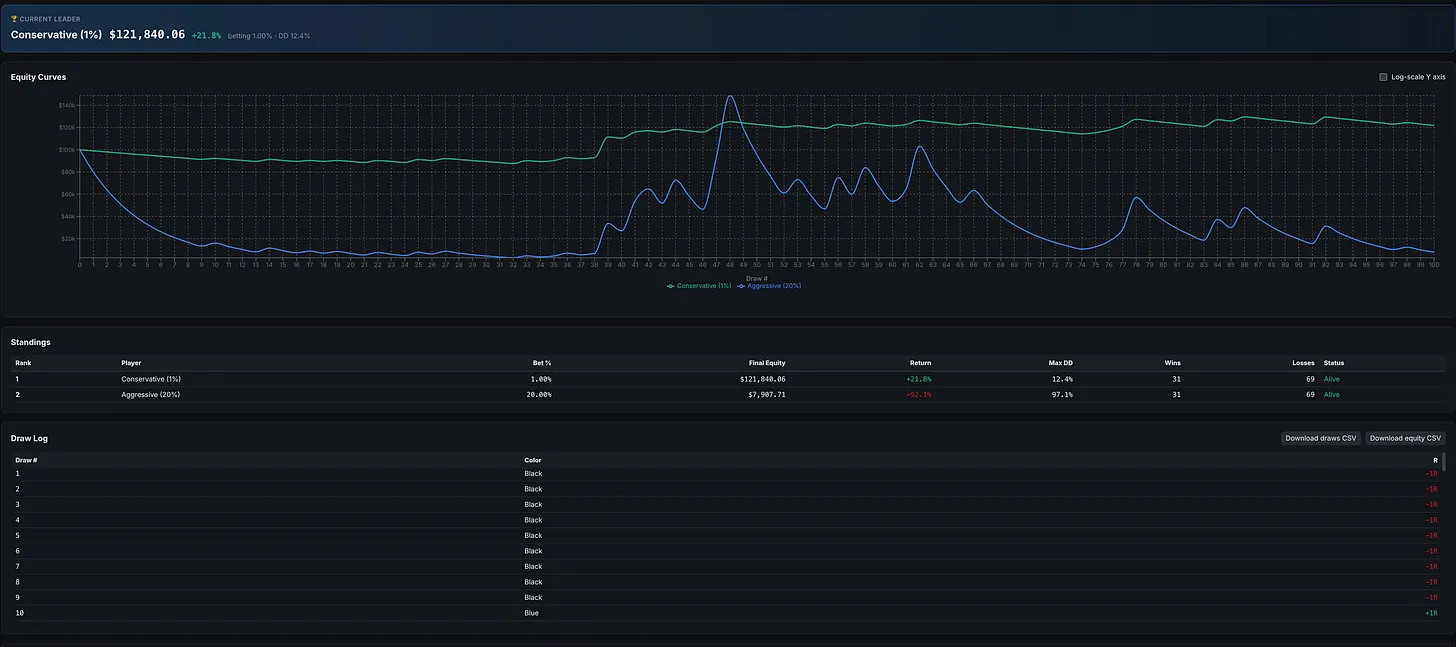
Another important feature is the ability to set a maximum drawdown threshold. This changes the game from a pure return contest into a risk-adjusted performance exercise.
Instead of asking only who finished with the highest equity, the trader can ask who finished with the highest equity while staying within a predefined drawdown limit.
That is a much more realistic way to think about trading.
Most traders do not simply want the highest possible return at any cost. They want growth, but they also want survivability. They want upside, but they want to avoid the kind of drawdown that damages confidence, forces liquidation, or causes them to abandon the strategy.
A 300% return with an 80% drawdown may look impressive in a spreadsheet, but it may be unusable for a real person managing real capital.
Position sizing is where those trade-offs are made.
The Institutional Way to Think About Position Sizing
This is why the Marble Game remains such an important exercise. It teaches that risk management is not separate from performance. Risk management is part of performance. The size of each position determines how much of the system’s expectancy can be captured and how much volatility the trader must endure to capture it.
The deeper lesson is that every trader needs objectives. “Make as much money as possible” is not a complete objective. A complete objective requires defining the desired return, the maximum acceptable drawdown, the time horizon, and the type of equity curve the trader is actually capable of following.
Once those objectives are defined, position sizing becomes the tool used to pursue them.
That is the institutional way to think about the game.
The Marble Game is not just about marbles, bets, or random outcomes. It is a model for understanding how a trading edge interacts with capital allocation. It shows why the same system can produce very different outcomes across different traders. It also shows why the best position size is not universal. It depends on the strategy, the return objective, the drawdown constraint, and the trader’s ability to stay disciplined through normal variance.
Why This Is Especially Important for Momentum Traders
For momentum traders, this lesson is especially important.
Momentum strategies often rely on asymmetry. Many trades may produce small losses or modest gains, while a smaller number of large winners drive the bulk of performance. That means the trader must be positioned large enough to benefit when the outlier appears, but not so large that normal losses destroy the account before that outlier arrives.
The Marble Game helps traders feel that trade-off instead of just understand it intellectually.
It shows why a lower win-rate system can still be profitable. It shows why a high win rate does not guarantee strong performance. It shows why large winners matter. It shows why losing streaks must be expected. And most importantly, it shows why the amount risked on each trade can determine whether the trader survives long enough for the edge to work.
The Real Lesson of the Marble Game
That is the reason I added this tool to the Momentum Trading Strategy App.
The purpose is not entertainment. The purpose is education through simulation. Traders can test fixed sizing, progressive exposure, custom R-multiple distributions, drawdown limits, and their own performance data. They can compare different systems and see how each one behaves under different risk assumptions. They can study the relationship between position size, return, drawdown, and survivability.
The result is a much clearer understanding of what position sizing is actually supposed to do.
It is not just about maximizing return.
It is not just about avoiding ruin.
It is about designing a sizing strategy that allows the trader to pursue the objective while staying within the risk limits required to keep trading.
That is the real lesson of the Marble Game.
A trading system may define the edge, but position sizing determines whether that edge can be executed, endured, and compounded over time.
In the video below, I walk through how the Marble Game works inside the Momentum Trading Strategy app, how to run simulations, how to test different expectancy systems, how to use progressive exposure, and how to think about position sizing through the lens of both return and drawdown.
Want to Go Deeper?
All-Access includes the Momentum Trading Strategy Course, MTS Velocity software, and the Big Picture Market Pulse newsletter.
