
Understanding Backtesting, Modeling, and Forward Testing: Methods for Validating Trading Strategies
How Top Traders Use Backtesting, Modeling, and Forward Testing to Build and Trust Their Edge

In trading, everyone talks about having an edge. Far fewer traders understand how that edge is actually developed, validated, and trusted over time.
Today, much of the online trading world treats backtesting as the gold standard for proving a strategy. The message is often simple: if you have not backtested it, you do not have an edge. There is truth in that idea, especially for systematic traders. Backtesting can be extremely useful. It can help a trader study historical probabilities, identify weaknesses, measure drawdowns, and determine whether a rules-based strategy has positive expectancy before capital is placed at risk.
But backtesting is not the only way traders build confidence in a system. It is also not a substitute for judgment, execution, risk management, or experience. Many of the best traders in history did not build their entire approach by endlessly testing variables in a spreadsheet. They studied prior winners, modeled successful traders, developed rules, traded with small risk, reviewed results, and refined their process over time.
Backtesting can help prove whether an idea may have worked in the past. Modeling can help a trader adopt principles that have already been proven by others. Forward testing can show whether the trader can actually execute the strategy in real time, under real market conditions, with real emotions involved.
The goal is not to choose one method and reject the others. The goal is to understand the role each method plays and to avoid turning research into procrastination.
Backtesting: Historical Evidence, Not Perfect Certainty
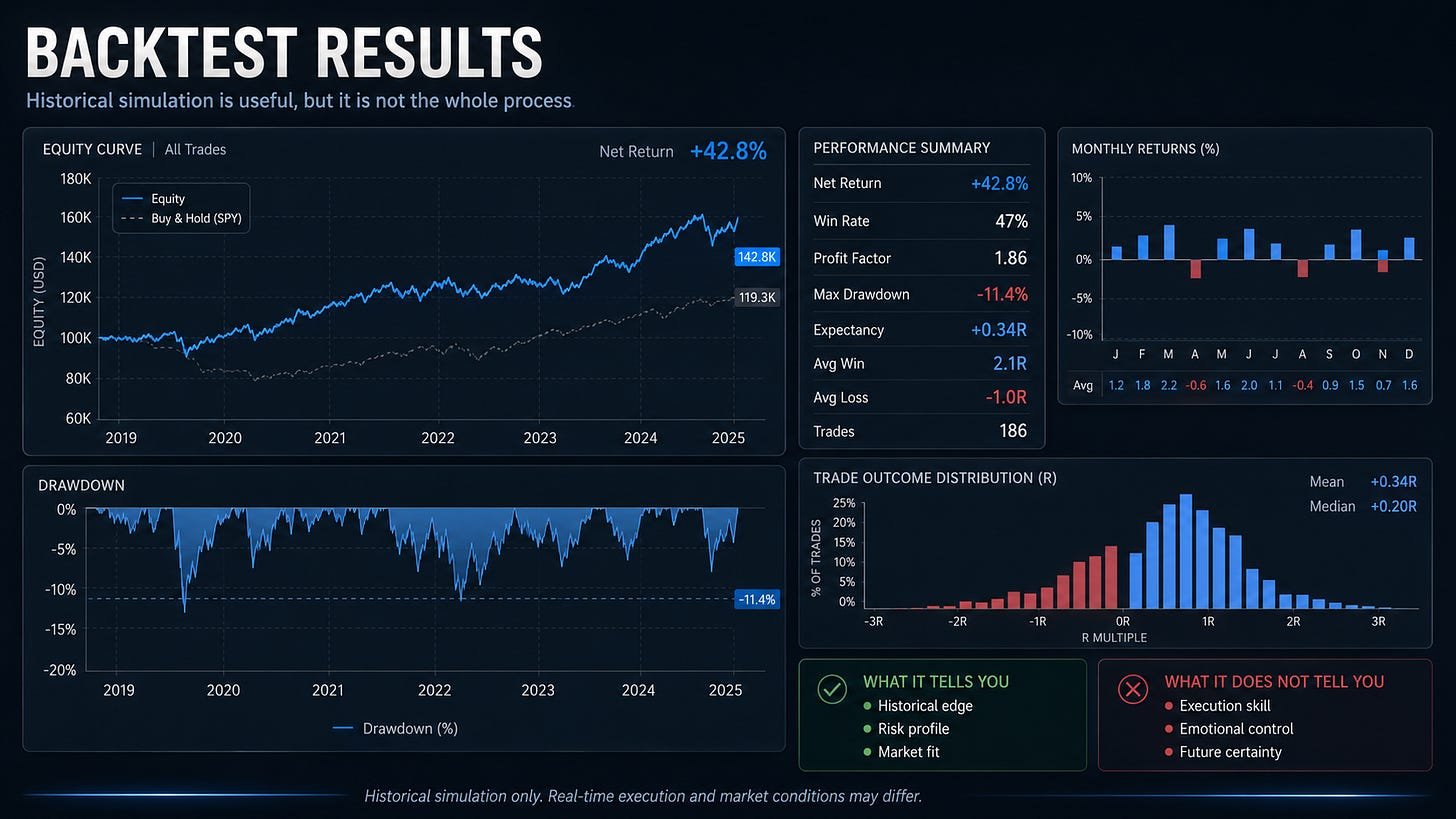
Backtesting is the process of applying a trading strategy to historical market data to see how it would have performed. For mechanical or rules-based systems, it can be one of the most useful tools available. If a strategy has clearly defined entry rules, exit rules, stop-loss levels, position sizing guidelines, and market filters, historical testing can help determine whether the approach has a logical edge.
A proper backtest can answer important questions.
How often does the setup work?
What is the average gain compared with the average loss?
What type of drawdown should be expected?
Does the strategy perform better in certain market environments?
Does it rely on rare outlier trades, or does it produce consistent expectancy across a broad sample?
These are valuable questions. A trader who never studies historical performance may be relying too heavily on opinion, emotion, or a few recent examples. Backtesting forces a strategy to face evidence.
The problem begins when traders expect backtesting to provide certainty. Markets are adaptive. Conditions change. Liquidity changes. Leadership changes. Volatility changes. A strategy that looked excellent in historical testing can still fail when traded poorly, over-optimized, or applied in the wrong environment.
There is also the danger of curve-fitting. A trader can keep adjusting variables until the backtest looks nearly perfect, only to discover that the “perfect” system was simply designed to fit the past. The more a strategy is optimized around historical data, the greater the risk that it will disappoint in live markets.
Backtesting is useful when it helps a trader understand probability. It becomes dangerous when it creates the illusion that uncertainty has been eliminated.
When Backtesting Becomes Procrastination
Many traders do not fail because they backtest. They fail because they never leave the backtesting stage.
They continue testing different settings, indicators, lookback periods, market filters, and exit rules in search of the perfect system. But the perfect system does not exist. Every legitimate strategy has drawdowns. Every strategy has losing streaks. Every strategy has periods where it underperforms. No amount of testing will remove that reality.
At some point, the trader has to learn whether the strategy can be executed.
Can the trader take the entry when the setup appears?
Can the trader accept the stop when it is hit?
Can the trader sit through normal volatility without interfering?
Can the trader hold a winner long enough for the edge to matter?
Can the trader avoid increasing size at the wrong time or abandoning the process after a few losses?
Those questions cannot be answered by historical data alone. They require real-time experience.
This is where many traders confuse research with progress. Research matters, but it is not the same as execution. A trader can build a beautiful backtest and still fail because they cannot follow the system when money is on the line.
Backtesting can show what may have worked. It cannot prove that the trader has the discipline, patience, and emotional control to trade it properly.
Modeling: Learning From Proven Traders and Proven Systems
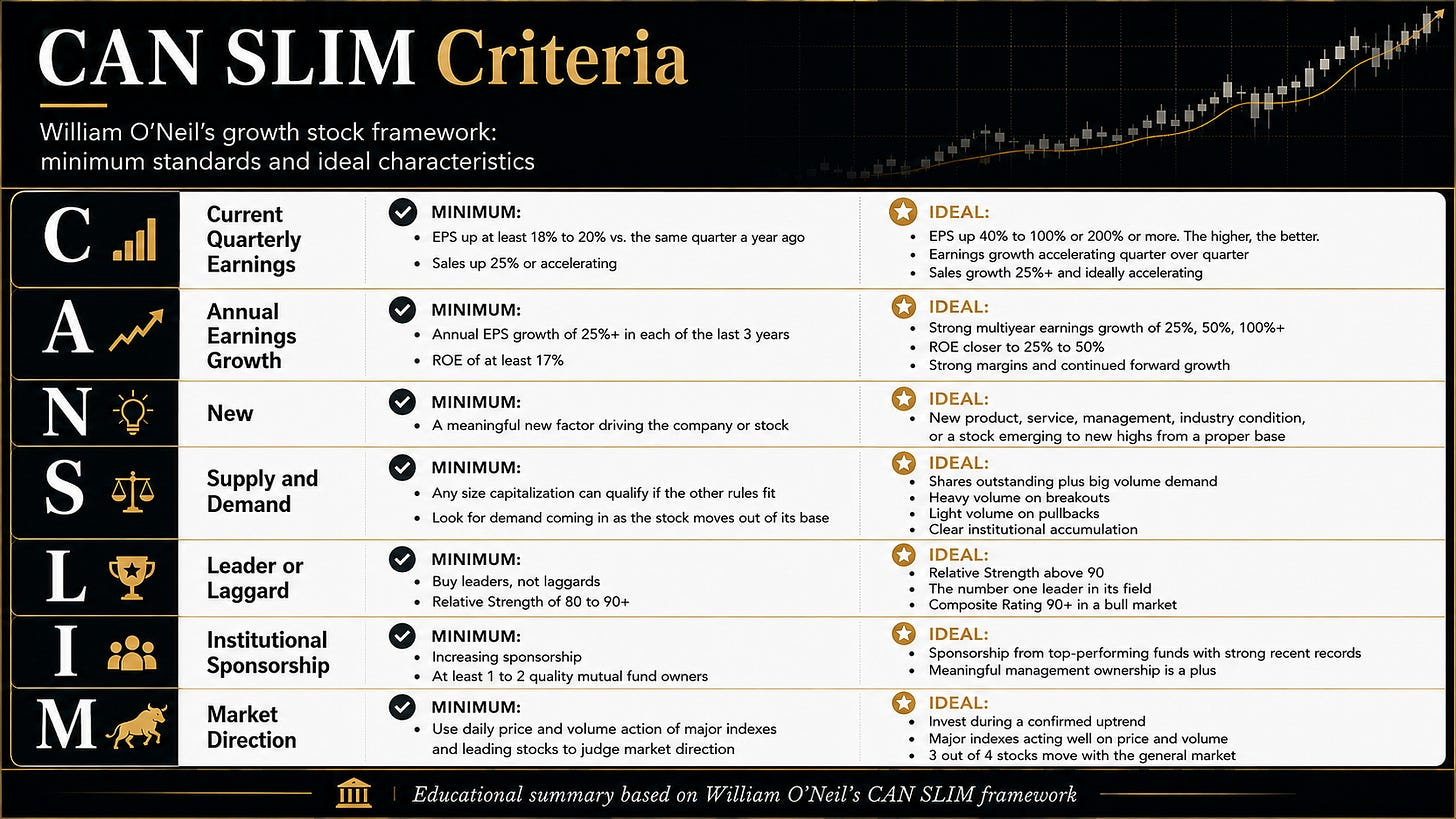
Modeling is one of the most overlooked methods of developing a trading process. It means studying the methods, principles, behaviors, and risk controls of traders who have already achieved success, then building a structured approach around what has been proven to work.
This is not blind copying. It is intelligent imitation.
A baseball player does not need to reinvent the swing from scratch. He can study a great hitter, model the mechanics, practice the movement, and then adapt it to his own body, timing, and strengths. Trading works the same way. A trader does not need to rediscover every principle from zero. He can study great traders, learn their frameworks, understand why their methods worked, and then adapt those principles to his own timeframe, risk tolerance, and personality.
William O’Neil’s CANSLIM method is an example of modeling built from historical research. O’Neil studied the greatest winning stocks and identified the recurring fundamental and technical characteristics that appeared before their largest advances. His work gave future traders a framework they could study, apply, and refine without needing to personally recreate decades of market research from scratch.
Mark Minervini modeled elements of O’Neil, Love, Livermore, Darvas, and other great traders, then refined those ideas into his own process. Nicolas Darvas developed a momentum-based model around price boxes, strength, and risk control. Richard Dennis and William Eckhardt built the Turtle trading system around tested trend-following principles, then trained traders to execute the model. Dr. Van Tharp studied top traders by modeling their beliefs, position sizing methods, and risk management behaviors rather than focusing only on chart patterns.
The point is: many trading principles have already been tested by history. Cutting losses, trading with the trend, buying strength, focusing on leadership, managing risk, avoiding large drawdowns, and letting winners run are not new ideas. They have appeared repeatedly in the work of successful traders across different eras, markets, and styles.
A trader does not always need to prove from scratch that these principles have value. In many cases, the more important task is learning how to apply them correctly.
Why You Do Not Always Need to Reinvent the Wheel
One of the biggest mistakes newer traders make is assuming they must create a completely original system. They believe that unless they personally code it, test it, and optimize it, the edge is not valid.
That is not how many successful traders develop.
Many traders start by studying a proven framework. They learn the logic behind it, understand the conditions where it performs best, practice identifying the setups, apply risk controls, and then forward test the process with small size. Over time, they personalize the method based on their own strengths and weaknesses.
This is not a shortcut. It is how skill is often developed in every serious field.
A musician studies great musicians. An athlete studies great athletes. A business owner studies great operators. A trader studies great traders.
The key is not to copy surface-level tactics without understanding them. The key is to understand the principles behind the method.
Why does the system work?
Where does the edge come from?
What market environment does it need?
What are the risks?
What type of drawdown should be expected?
What kind of personality is best suited for it?
If a trader models a proven system without understanding the underlying logic, they will likely abandon it during the first difficult period. If they understand the reasoning behind the system, they can develop conviction without needing to personally reinvent every piece of it.
This is especially true in discretionary trading. Many discretionary strategies do not translate cleanly into a mechanical backtest. Tape reading, market context, leadership analysis, price-volume interpretation, and trade management often involve judgment. That does not make them invalid. It means they require a different type of validation.
What Dr. Van Tharp Adds to the Discussion
Dr. Van Tharp’s work adds an important layer to this discussion because he did not treat trading success as merely a search for the perfect entry signal or the perfect historical test. His work centered on modeling successful traders, defining objectives, understanding expectancy, tracking R-multiples, and using position sizing to meet a trader’s specific goals.
In Trade Your Way to Financial Freedom, Tharp’s system-development process begins with self-inventory and objectives, then moves into studying historical moves, identifying the concept behind those moves, objectively measuring the concept, adding stops and transaction costs, determining expectancy, and optimizing through position sizing. That is a far more complete process than simply asking whether an entry signal looked good in a backtest.
This is important because Tharp’s framework connects all three validation methods. Historical study and backtesting can help reveal whether a concept has merit. Modeling helps traders learn from market geniuses and proven principles. Forward testing and trade journaling allow traders to convert real results into R-multiples, evaluate expectancy, and determine whether they can actually execute the system in live conditions.
Tharp also warned against false confidence. Simulations can be useful, but they are not reality. R-multiple distributions may be inaccurate, market types can change, and correlated positions can make drawdowns worse than expected. In other words, the numbers matter, but they must be interpreted with humility.
That is the real takeaway. The goal is not to build a perfect theoretical system. The goal is to understand the edge, define the risk, track the results, size positions properly, and develop a system the trader can actually follow.
Forward Testing: Real-Time Proof
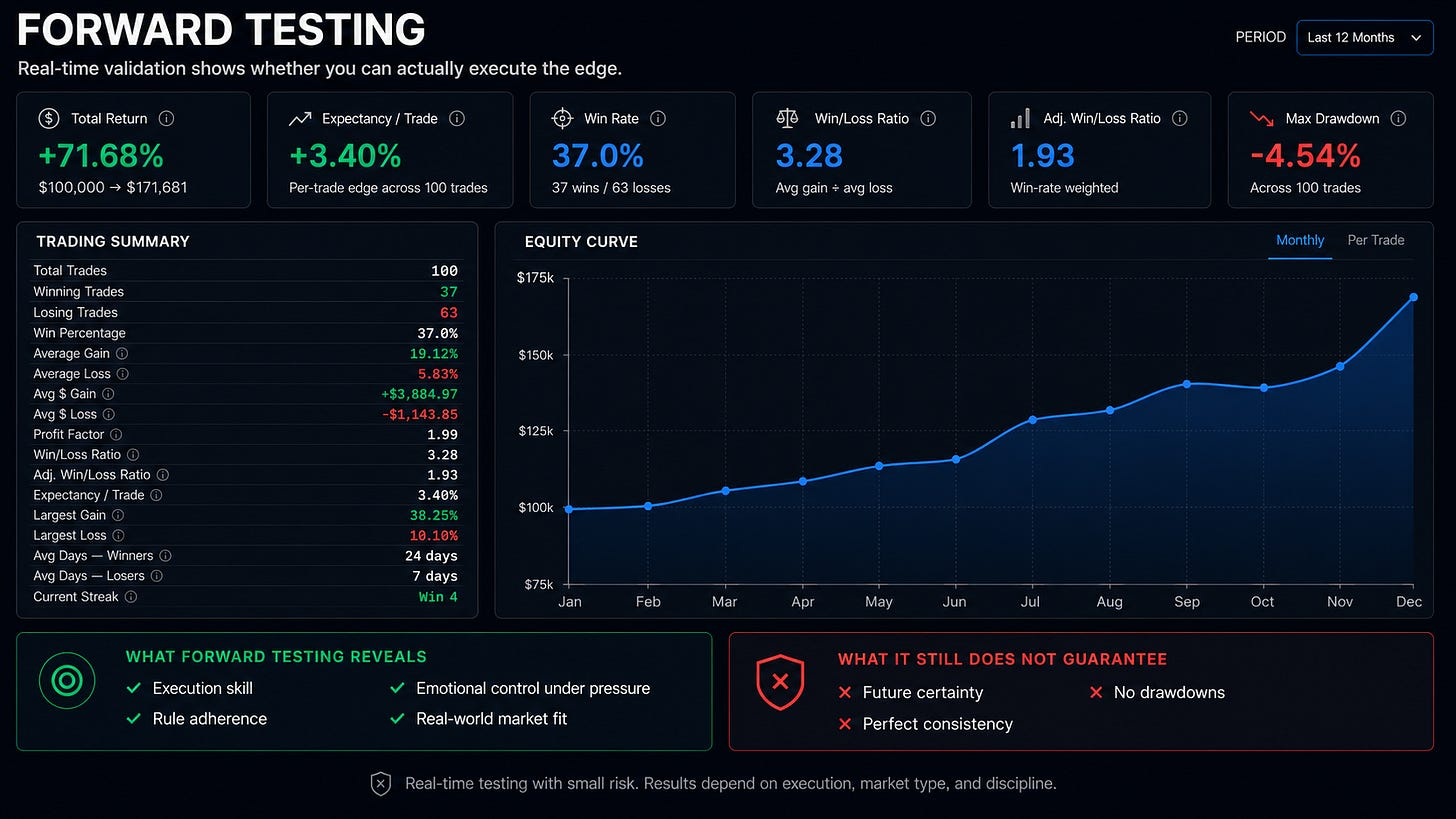
Forward testing is the process of testing a strategy in real time. This can be done in a simulator, on paper, or with small amounts of capital. The objective is not to make meaningful money immediately. The objective is to determine whether the strategy works under current market conditions and whether the trader can execute it properly.
Forward testing reveals things backtesting cannot. It shows how a setup looks before the outcome is known. It exposes hesitation, fear, impatience, and overconfidence. It shows whether stops are actually followed. It shows whether the trader takes profits too early or lets losses get out of control. It shows whether the trader can sit through normal volatility without constantly interfering with the trade.
This matters because a trading strategy does not exist in a vacuum. It is executed by a human being. Even a system with positive expectancy can fail if the trader cannot follow it.
For discretionary traders, forward testing may be even more important than heavy backtesting. A trader who uses price action, volume, relative strength, leadership, market context, and intraday behavior may not be able to code every decision into a clean historical test. The edge may come from pattern recognition, experience, and judgment.
That kind of edge still needs to be validated, but the validation often comes from real-time repetition, journaling, chart review, and performance tracking. The trader places trades with small risk, records the setup, reviews the decision-making process, studies the outcome, and gradually determines whether the approach has positive expectancy.
Backtesting asks, “Could this have worked in the past?”
Forward testing asks, “Can I trade this now?”
Those are two very different questions.
The Best Traders Are Looking for Evidence, Not Certainty
The best traders are not trying to eliminate uncertainty. They understand that uncertainty is part of the game. Their goal is to develop enough evidence to justify taking risk, while keeping that risk small enough to survive when they are wrong.
That evidence can come from different sources. It may come from a formal backtest. It may come from modeling a proven system. It may come from studying thousands of historical examples. It may come from forward testing a strategy with small size. It may come from a combination of all of the above.
What matters is that the trader has a reason to believe the process has positive expectancy and a plan for managing risk when the edge does not immediately show up.
A professional process should answer several questions.
What is the edge?
Why should it work?
Has it worked historically or been proven by other traders?
What market environment does it require?
What are the expected losses and drawdowns?
How will position size be determined?
What invalidates the trade?
How will results be reviewed?
Backtesting can help answer some of these questions. Modeling can help answer others. Forward testing brings the process into reality.
The mistake is believing that one method automatically solves everything.
The Social Media Trap
Social media has created the impression that backtesting is the only serious way to validate a strategy. That view is too narrow.
Backtesting is important, but many successful swing traders, position traders, and discretionary traders do not rely on heavy formal backtesting the way social media often suggests. Many traders build their foundation by studying a proven mentor, course, or book, such as William O’Neil’s How to Make Money in Stocks, and then begin applying those lessons with a small amount of capital.
That does not mean they are trading blindly. It means their validation process looks different. They are modeling a proven framework, applying it in real time, tracking their results, refining their rules, and learning which market environments give the strategy its best chance to work.
Over time, forward testing and modeling help the trader determine whether the process produces positive expectancy. In simple terms, positive expectancy means the strategy is profitable over a large sample of trades, assuming the trader follows the rules, trades it in the right market type, manages risk properly, and controls the psychological and emotional mistakes that can destroy even a valid edge.
That is still evidence. It just does not always look like a spreadsheet.
A trader who studies the greatest winning stocks of the past, models the rules of successful traders, tracks current leadership, reviews trades, manages risk, and forward tests with small size is still doing serious work. The process may be less mechanical, but it can still be rigorous.
The real issue is not whether a trader uses backtesting. The real issue is whether the trader has a repeatable process, understands where the edge comes from, controls risk, tracks results honestly, and trades the strategy in the right market environment.
A trader with a simple proven model and disciplined execution can outperform a trader with an impressive backtest and no ability to follow it.
A Practical Framework for Traders
For most traders, the best approach is not to reject backtesting. It is to put backtesting in its proper place.
If the strategy is mechanical, backtesting may be essential. A rules-based system should be tested across enough historical data to understand its expectancy, drawdowns, and weaknesses. If the strategy is discretionary, backtesting may be useful, but it may not capture the full edge. In that case, modeling, chart review, journaling, and forward testing may play a larger role.
A practical path is to begin with the core idea. The trader should understand why the strategy should work and where the edge comes from. From there, the trader can study whether the principle has historical support. That may come from backtesting, from market studies, or from the documented success of traders who used similar methods.
Next, the trader should build a model. This means defining the setup, entry criteria, risk parameters, position sizing, trade management rules, and exit logic. The model does not need to be perfect, but it needs to be clear enough to execute and review.
Finally, the trader should forward test the model. This can be done with small size until the trader has enough real-time evidence to evaluate both the strategy and their own execution. The goal is not to rush into large positions. The goal is to develop trust through repetition, review, and measured improvement.
That is how a process becomes tradable.
Final Thoughts
Backtesting is useful, but it is not the only path to an edge. It can help traders understand historical probabilities and avoid obvious mistakes, but it cannot replace modeling, forward testing, execution, and risk management.
Many proven trading principles have already been studied, tested, traded, and written about for decades. A trader does not always need to reinvent the wheel. Sometimes the better path is to study what has already worked, model proven traders, understand the underlying logic, and then test the approach in real time with controlled risk.
The goal is not to build the perfect theoretical system. The goal is to develop a process with positive expectancy that fits the trader’s personality, timeframe, account size, and risk tolerance.
At some point, research has to become execution. The trader has to stop searching for certainty and start building skill. That means putting enough work into the strategy to understand the edge, then forward testing it, tracking results, managing risk, and improving over time.
Backtesting can help build confidence. Modeling can provide direction. Forward testing can prove whether the trader can actually execute and follow it.
Used together, they create a much stronger foundation than any one method alone.
Want to Go Deeper?
All-Access includes the Momentum Trading Strategy Course, MTS Velocity software, and the Big Picture Market Pulse newsletter.
